

If you follow Strategy (MSTR), you’ve seen the fight.
On one side, you have the “Strategy is a Ponzi” sceptics.
On the other side, the “Strategy is a new paradigm” believers.
Both sides think they’re arguing about Strategy.
In this article I outline why that fight is part of the Strategy.

The Strategy playbook
Strategy began in 1989 selling data software. The software made money and cash grow on the balance sheet.
In 2000, the stock surged with the dot-com bubble. When the bubble burst and things settled, returns from roughly 2004 to 2020 stayed weak.
During those years, cash kept building and that became a problem as the cash earned little interest. It sat there and lost purchasing power.
The CEO Michael Saylor saw that the operating business worked, but the treasury was a melting ice cube and the flat stock price told the story.
So in 2020, Strategy made a move and used some of its cash to buy 21,000 Bitcoin.
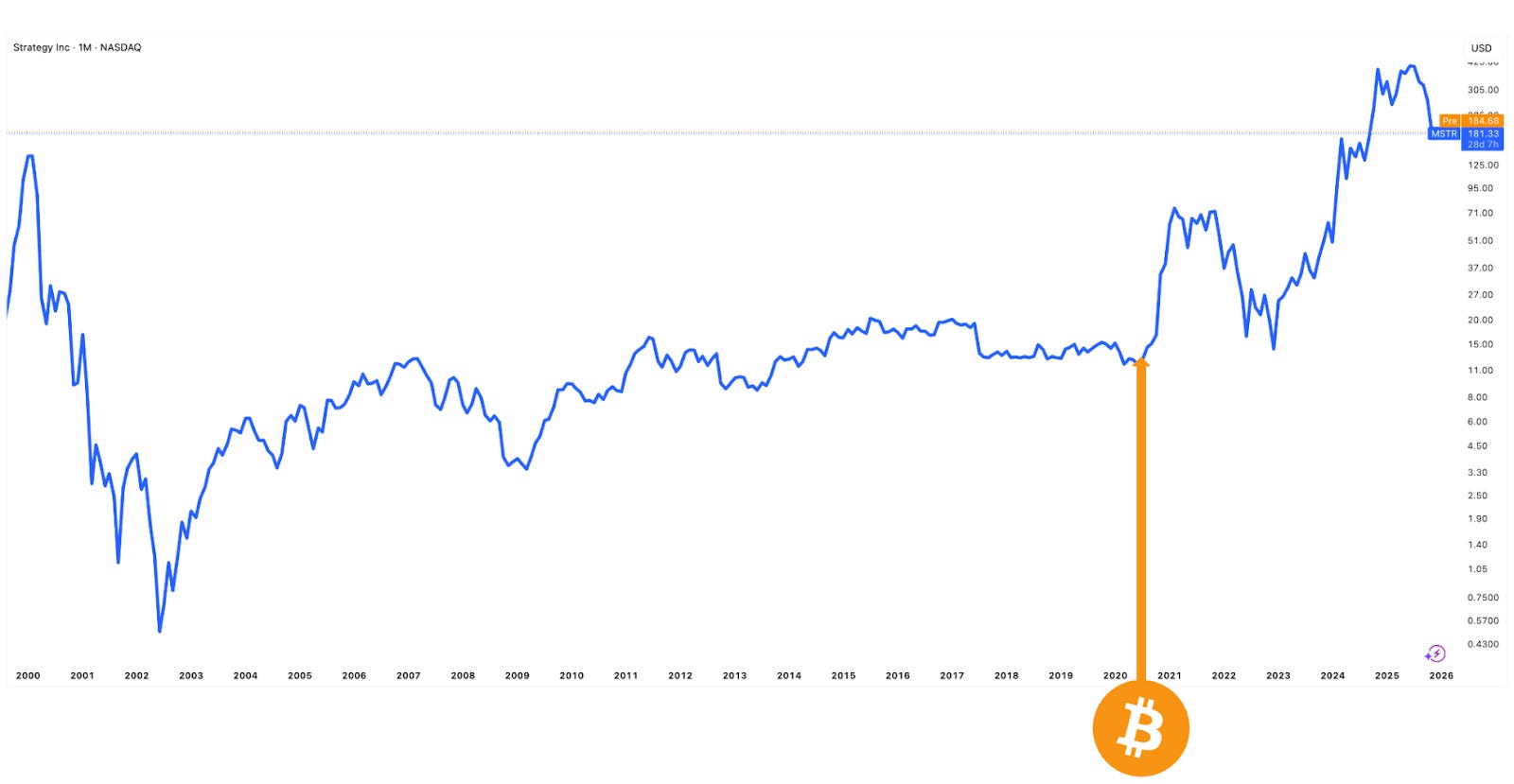
Bitcoin rose → MSTR rose → Conviction in Bitcoin grew.
Then came the 2022–2024 crypto winter. Prices fell hard and Strategy bought more. After Bitcoin recovered, the Bitcoin balance sheet became the business.
As of December 2025, Strategy held about 671,268 Bitcoin, over 3% of total supply.
The software business still makes money, but most of Strategy’s value now comes from unrealised gains on Bitcoin.
The thesis is simple: Those unrealised gains must outrun balance-sheet liabilities before markets lose patience.
So far, they have. Fiat keeps losing buying power as Bitcoin has gained it. If that gap holds long enough, Strategy survives.
What Are They Doing With All That Bitcoin?
Strategy uses the unrealised gains on its Bitcoin as collateral. With their preferred shares, they turn Bitcoin’s volatility into financial products.
These trade under tickers like STRC, STRF, STRD, and STRK. Readers who want the mechanics can find them in Strategy’s investor materials.
Each product pulls a different risk out of the same underlying Bitcoin and hands it to a different buyer.
Instead of experiencing all Bitcoin’s ups and downs, investors can buy a preferred that provides steady income. They earn regular dividends and avoid the biggest swings in either direction.
Strategy keeps the long-term exposure. Investors trade volatility for income.
The Star of the Show: STRC
Stretch (STRC) has been the standout success.
It raised ~$2.5 billion and became the largest US IPO of 2025.
The appeal is simple. It pays a variable yield around 10 to 11 percent a year, paid monthly, and it aims to trade near $100.
Park $100,000 and you collect roughly $850 to $900 a month before tax, depending on price and rate.
If STRC trades below par, Strategy raises the dividend. If it trades above par, Strategy issues more shares.
That push-pull helps keep the price close to target, even though it can drift.
Dividends come from a multi-billion dollar cash reserve and new preferred-share issuance. Which brings us to the real engine.
The Confidence Flywheel
STRC and the other preferreds run on a loop:
Strategy sells shares into the market
It uses the cash to pay dividends
Dividends support the price
A steady price keeps capital markets open
Open markets allow more issuance
Round it goes.
Bitcoin sits behind the structure as long-term collateral. But Bitcoin does not fund dividends, at least not yet. Capital does.
And capital shows up only while confidence holds.
This is where the whole structure lives or dies.
When capital is easy, the flywheel spins. When access tightens, it slows. If any part falters, pressure can build fast. You would see it first in the preferreds trading well below par.
In an extreme case, Strategy could sell Bitcoin to fund dividends. That would shake confidence, spook the market, and jam the flywheel even harder.
Confidence, Cult, and Polarisation
Any structure dependent on repeated capital access needs conviction.
And conviction peaks in conflict.
If you’ve lived through more than one Bitcoin cycle, you know the pattern. Years of ridicule. Bitcoin obituaries. None of it weakens belief. It sharpens it.
The same dynamic plays out here.
Enter Michael Saylor.
Saylor talks about bitcoin like a force of nature:
#Bitcoin is a swarm of cyber hornets serving the goddess of wisdom, feeding on the fire of truth, exponentially growing ever smarter, faster, and stronger behind a wall of encrypted energy.
Add his AI-generated Twitter posts. Saylor in the Matrix. Saylor on rockets and sinking ships. Likes and retweets flood in and outrage follows.

Skeptics see obvious fraud. Believers see proof you don’t get it.
Each side hardens the other.
This polarisation manufactures conviction at scale.
And conviction keeps the flywheel turning.
Real Risks, Real Opportunities
Between the skeptics and believers sit the real risks and opportunities:
Price
STRC gravitates toward $100, but it does not live there. It has traded into the low $90s. Sell at the wrong time and you lock in a loss. Buy during those dips, and the effective yield rises. And if the price trades back to par you also get the benefit of capital gains.
Dividend
Dividends are variable. Strategy raises them to defend price. It can cut them too, and that flexibility is part of what allows the structure to adapt to market conditions.
Currency
Payments arrive in dollars. The dollar has a perfect record of losing purchasing power, which is part of why the yield is relative high to begin with.
Timing
Even if Bitcoin wins over decades, the path matters. Long drawdowns or stagnant pricing can result in tight capital markets that strain the flywheel.
Bitcoin
Everything rests on Bitcoin beating Strategy’s fiat liabilities over time. If it does, the structure holds, and you get compensated for taking the risk.
Closing Thought
At the start, I said the fight between the skeptics and believers is the Strategy.
Reading this, reacting to it, trading it, ignoring it. All of it feeds the same flywheel.
It is in understanding that this fight is the trade and deciding whether you want to live inside it.
Regarding STRC, excellent continuation of your analisis.