

Visit any investing forum and you’ll see the same advice on a loop: “Just VOO and chill”, which is internet meme-speak for “Just buy the S&P 500 to the total exclusion of individual stocks or other asset classes”.
Every social media platform is full of investors piling into low-cost index funds, like VOO 0.00%↑, with every paycheck, come rain or shine. If you ask them why they adopted this strategy, they might point to two stats:
The 10-Year CAGR: An outstanding annual return of 13.65%.
The Active Failure Rate: Around 85% of actively managed funds fail to beat the S&P 500 over a 5-year period.
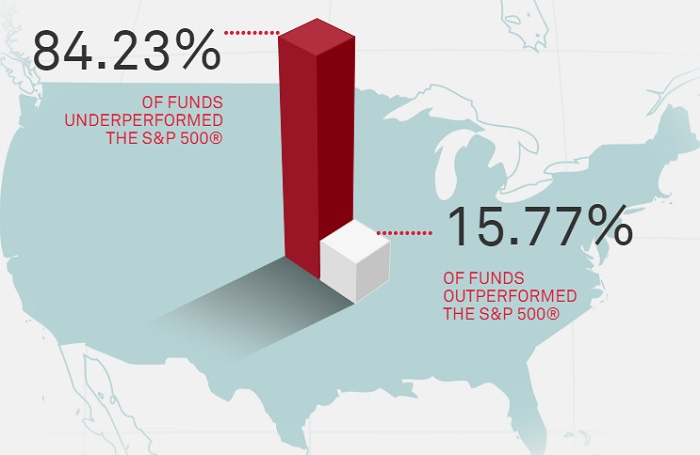
These are impressive stats, but several less-discussed macro shifts suggest that the next decade of S&P 500-only investing may be less impressive than the last.
That’s not to say you should ditch the S&P entirely… For many investors, having an allocation to the S&P makes perfect sense. But the all-in index strategy should be reconsidered. I outline some modest portfolio adjustments I am making to weather index underperformance.
Brief History of the S&P 500
In 1975, Jack Bogle founded Vanguard, and the next year, he introduced the first index fund for individual investors. This fund tracked the S&P 500, which follows the top 500 US companies, weighted by their size.
Because the fund is market-cap weighted, when you invest, your money automatically flows most into the largest companies.
In 2026, index-investing is the norm. Some people put money in deliberately every month, adopting “VOO and chill” as a strict rule and not trying to time the market highs and lows. Others invest this way by accident through automatic enrolment in workplace pensions.
In both cases, money flows in without considering valuation. “Did you give me cash? Then buy.”
Problems with “VOO and Chill”
1. Overvaluation Risk
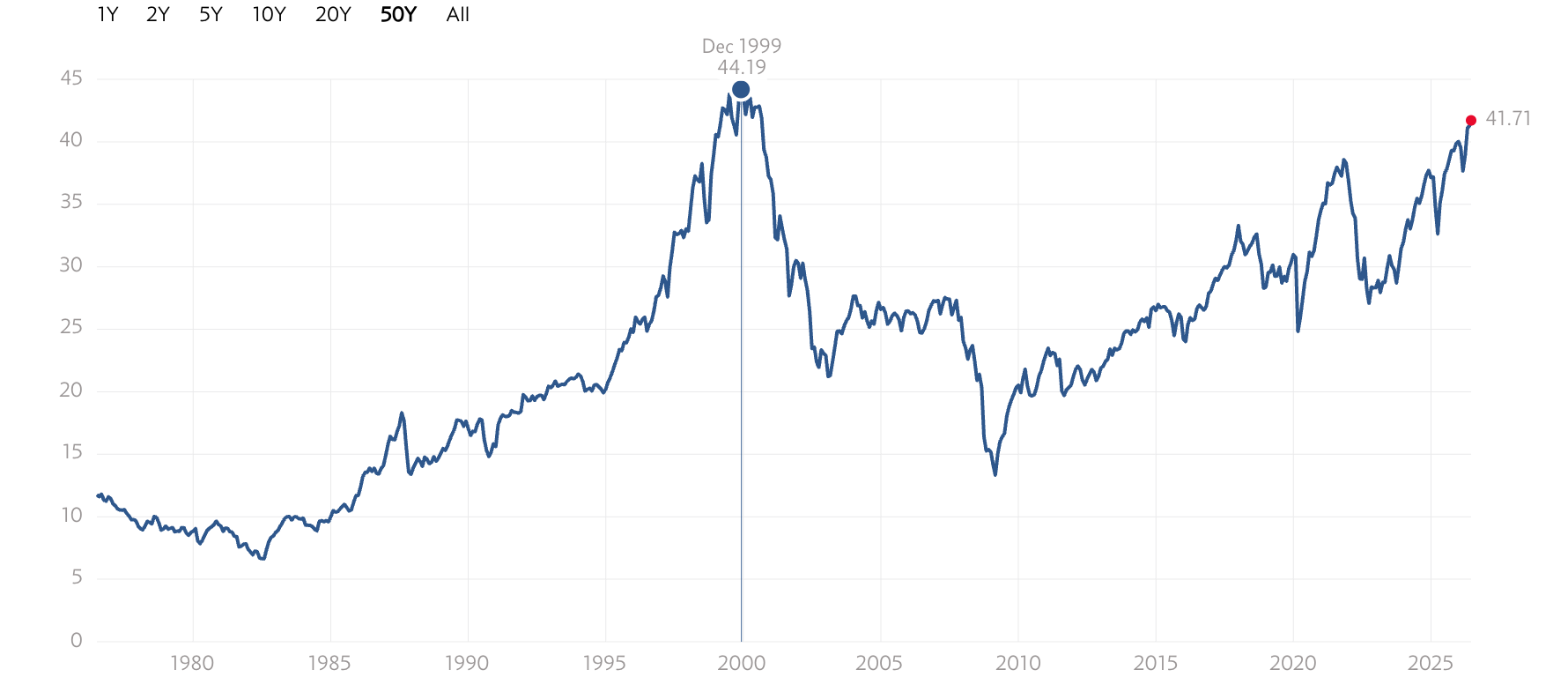
Dr. Robert Shiller, an economics professor and Nobel laureate at Yale, popularised the Cyclically-Adjusted Price-to-Earnings (CAPE) ratio, also known as the Shiller P/E ratio. CAPE compares the S&P 500’s current price to its average inflation-adjusted earnings over the last decade.
The CAPE ratio currently sits around 41, compared to a historical median of ~16. The only other time U.S. valuations reached this extreme was during the peak of the dot-com bubble.
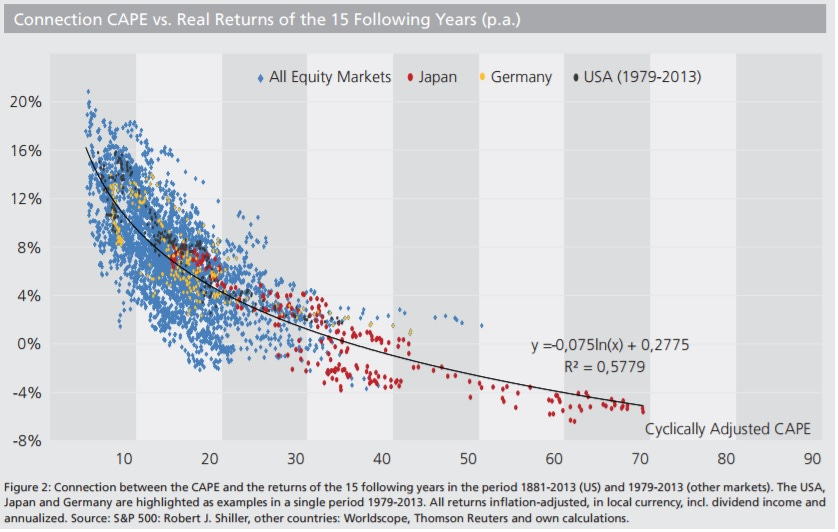
When you graph the CAPE on one axis and inflation-adjusted returns on the other axis, you get an inverse correlation. Historically, a higher CAPE has been associated with lower inflation-adjusted returns over the following 15 years:
2. The End of a 40-Year Tailwind
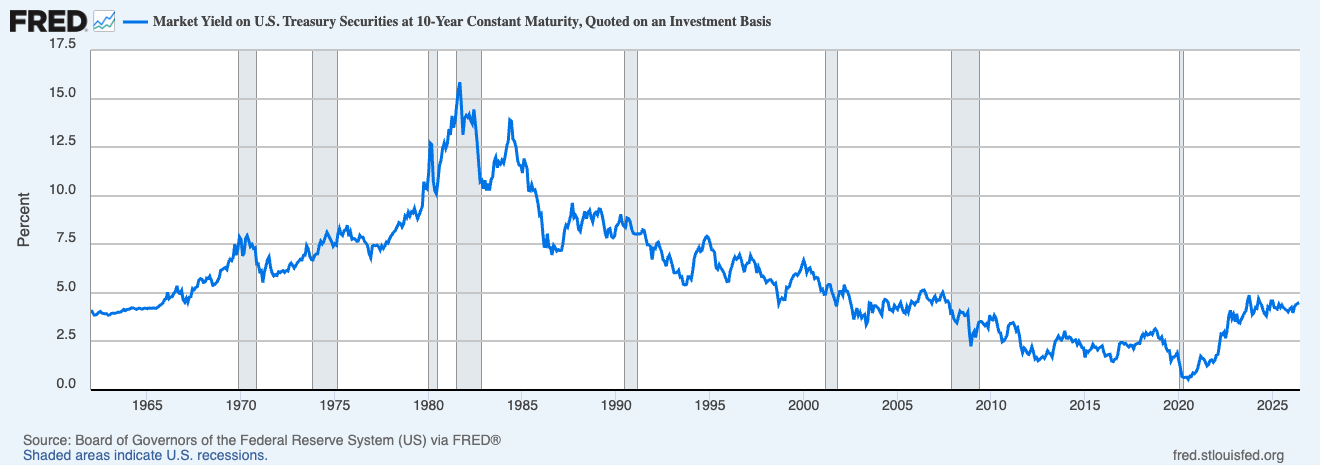
The 10-year Treasury yield affects many things, including mortgages and corporate debt. It was around 15% in 1981 and dropped to almost zero by 2020.
This decline over four decades was a part of the success of the index funds and US equities in general. As rates went down, stock valuations rose in part because future profits became more valuable today.
By 2020, rates had hit their lowest point, and that forty-year trend ended.
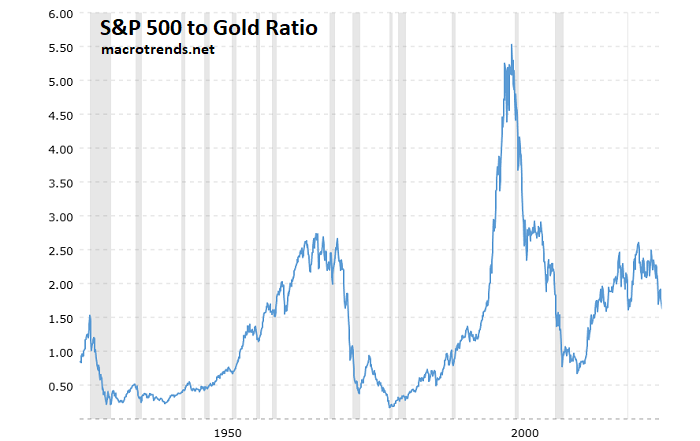
Although US stocks have risen in dollar terms since 2020, they have fallen when measured against gold. This highlights the distinction between nominal returns and purchasing power: an asset can rise in dollar terms while losing value relative to scarce assets during periods of monetary expansion.
3. Sentiment Is Stretched to Extremes
In 1976, at their inception, market-cap weighted index funds faced harsh criticism; detractors called them “un-American” and “a path to mediocrity.” This mirrored a general disdain for stocks, highlighted by BusinessWeek’s infamous 1979 cover declaring the “Death of Equities.”
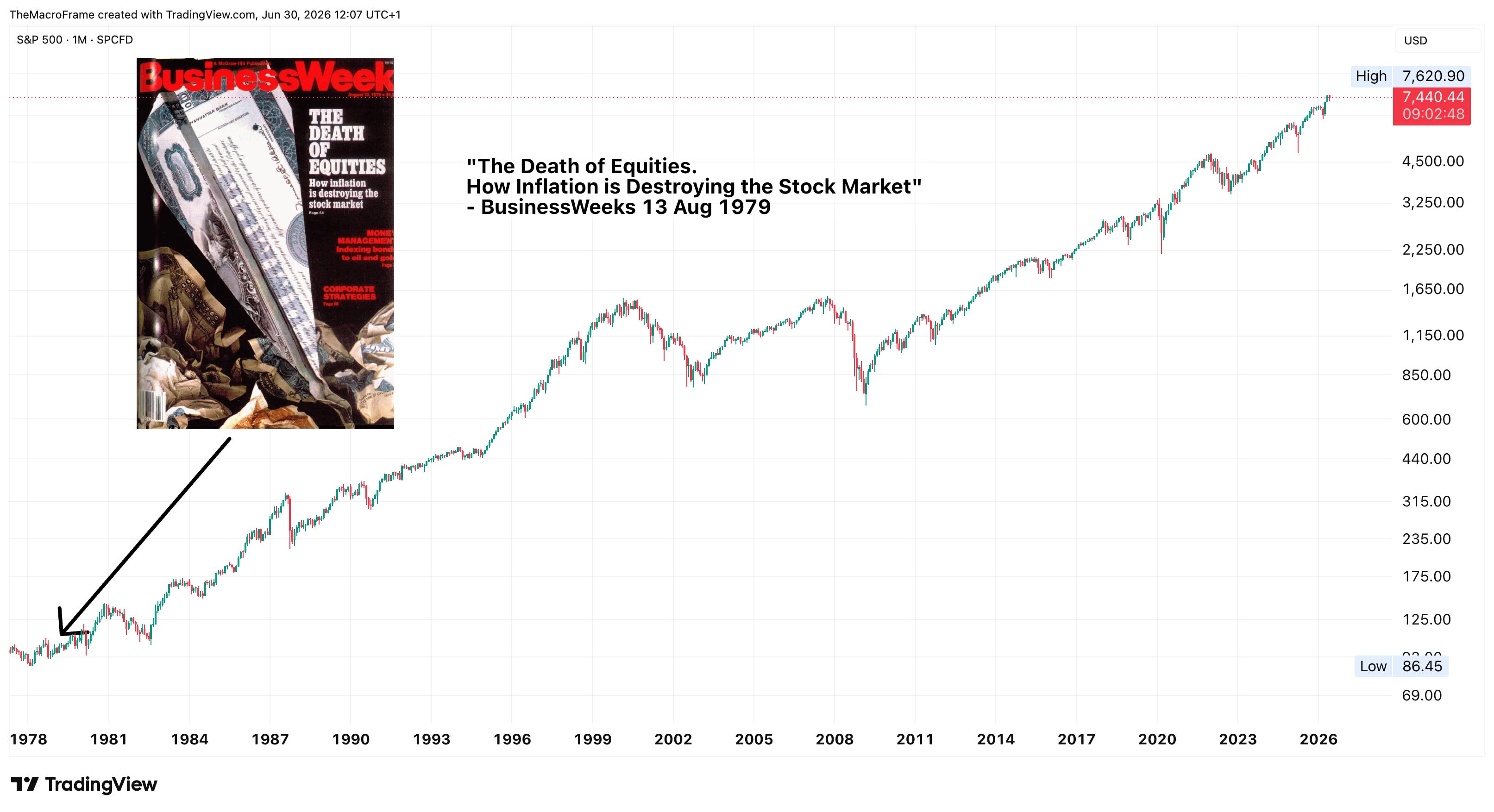
Poetically, that cover signalled a generational bottom for stocks. The haters gradually turned into buyers, which became tinder for a decades-long boom, with intermissions.
Today, sentiment has inverted: stocks are seen as a safe haven. Books, influencers and online communities increasingly promote ‘VOO and chill’-type investing frameworks.
What was once dismissed as foolish has become conventional wisdom. Just as extremely negative sentiment can accompany major market bottoms, extremely positive sentiment can emerge near long-term peaks in inflation-adjusted terms.
4. Concentration and Geopolitical Risk
While the U.S. still enjoys the largest capital markets in the world, trust in the U.S. as an economic safe haven is being tested.
Sanctions, tariffs and concerns about the global reach of US technology companies are affecting perceptions of the country and straining relations with some allies:

One in three German consumers now refuses to buy US products outright. In Austria, 71% say they’re prepared to boycott. In Sweden, the figure is 70%.
These surveys concern consumer behaviour rather than capital flows, but they illustrate the broader rise in economic nationalism.
Time will tell whether this trend is durable, and to what extent it hits US capital markets and equity valuations.
5. Demographics: The Changing of the Guard
During the historic bull run, Baby Boomers were in their peak earning years, providing a steady stream of market demand via payroll deductions.
Now, Boomers are retiring rapidly and shifting from net buyers to net sellers to fund their retirements.
Furthermore, the incoming generation views investing through a different lens: According to Bank of America’s 2026 Study of Wealthy Americans, younger investors put only 32% of their portfolios in stocks, compared to 58% for boomers, with the rest going into crypto, gold, and other alternatives.
How I am Mitigating These Problems
Faced with the above, I have built a portfolio that mitigates these risks while still allowing plenty of upside for equities.
My strategy is designed for me and my goals, but it may not work for you. I spend hours every week researching company fundamentals before investing. If you don’t have the time or interest for that, owning the index as a portion of your overall portfolio likely still makes sense, though you may want to consider a globally distributed index instead of a US-specific one.
Here is my portfolio composition:
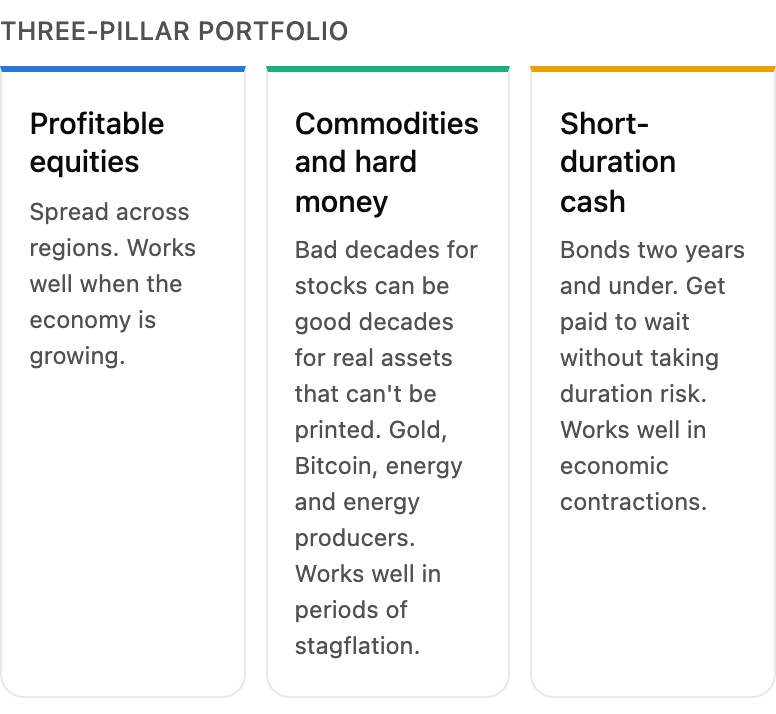
Profitable equities, distributed by region. In a multipolar world, I spread my investments across five continents rather than concentrating all my capital in a single US index. I favour profitable companies whose valuations and geographic exposure I have assessed directly, rather than accepting index weights mechanically.
Commodities and hard money. Bad decades for stocks can be good decades for other assets. The 1970s were terrible for equities but excellent for commodities and hard money. For this reason, I hold an allocation to physical commodities, including gold through Sprott trusts, alongside global energy producers and diversified miners. I also hold Bitcoin, which, together with gold, forms the hard-money portion that a traditional portfolio does not provide.
Short-duration bonds. I hold a defensive liquid buffer divided between short-term government bonds and money market funds to provide liquidity and reduce portfolio volatility in case of an economic contraction.
Final Words
While market-weighted index funds have been a brilliant option for many people, cracks are appearing, alongside record valuations and stretched sentiment.
Investors don’t need to choose between going all-in on the S&P 500 and picking individual stocks in the hope of finding the next ten-bagger.
There is another path, where we pay more attention to the changing world and make intentional, rational adjustments to our portfolios to accommodate it.
This is not a call for a crash in the S&P 500. It is a call for a greater probability of lower real returns over the next 10-20 years.
For the next few months, or even years, the thesis might look premature, especially if the S&P 500 continues rising. There could well be strong uptrends ahead. But over the next 10-20 years, I expect the inflation-adjusted return to disappoint. By the time that becomes evident, it will be too late to reposition.
Matt, interesting article, thank you for sharing your portfolio adjustment tips! I would be interested in how you see the same trends when it comes to the NASDAQ QQQ and options strategy? Also, I would point out the great amount of research you are putting in to decide what to invest in - I believe for a ‘regular’ investor indexs like S&P 500 are a relatively easy and time-saving choice. No continuous research needed, ‘just’ the faith in the US market continue rising :)