

On September 26th, the UK Government announced plans for Your First Home, a new equity-loan scheme in England designed to stimulate the new-build housing market, with details to be confirmed at the Budget.
At a glance:
Expected 2.5% deposit for first-time buyers
20% government equity loan
Initial interest-free period
New-build homes only
The reaction on social media was predictably binary: “this is great”, “this is awful”.
Whether it is good housing policy is not the question I’m trying to answer, though. I’m interested in what it could mean for investors.
UK Homebuilder Landscape
A relatively small group of large developers accounts for a significant share of the UK new-build market.
Barratt Redrow (LSE:BTRW), Persimmon (LSE:PSN), Taylor Wimpey (LSE:TW) and Bellway (LSE:BWY) are four of the largest. Before Barratt's merger with Redrow, these four alone accounted for around 25% of all new homes built in Great Britain.
In England, small developers built about 39% of new homes in 1988, but their share had fallen to just 10% by 2020.
Because the policy specifically targets new-build homes, some additional demand could flow to these larger listed companies, which is why I focus on them in this article.
Current State of Homebuilders
It’s fair to say that homebuilders have had a miserable few years.
Higher mortgage rates have made homes less affordable and lowered demand, while inflation, regulation, and higher building costs have made each new home more expensive to build.
The cost of borrowing for first-time buyers has also changed a lot. The average rate on a two-year fixed mortgage with a 95% LTV rose from 2.77% in December 2021 to 6.93% in August 2023. Although it dropped later, it was still about 5.5% in August 2026.
Home Builders Federation research estimates that regulation, taxation and inflation have added around £76,000 to the cost of building an average new home since 2020. Over that period, build costs have increased by around 25%, compared with a 12% increase in house prices.
UK Housebuilders Remain Well Below Their Cyclical Peaks
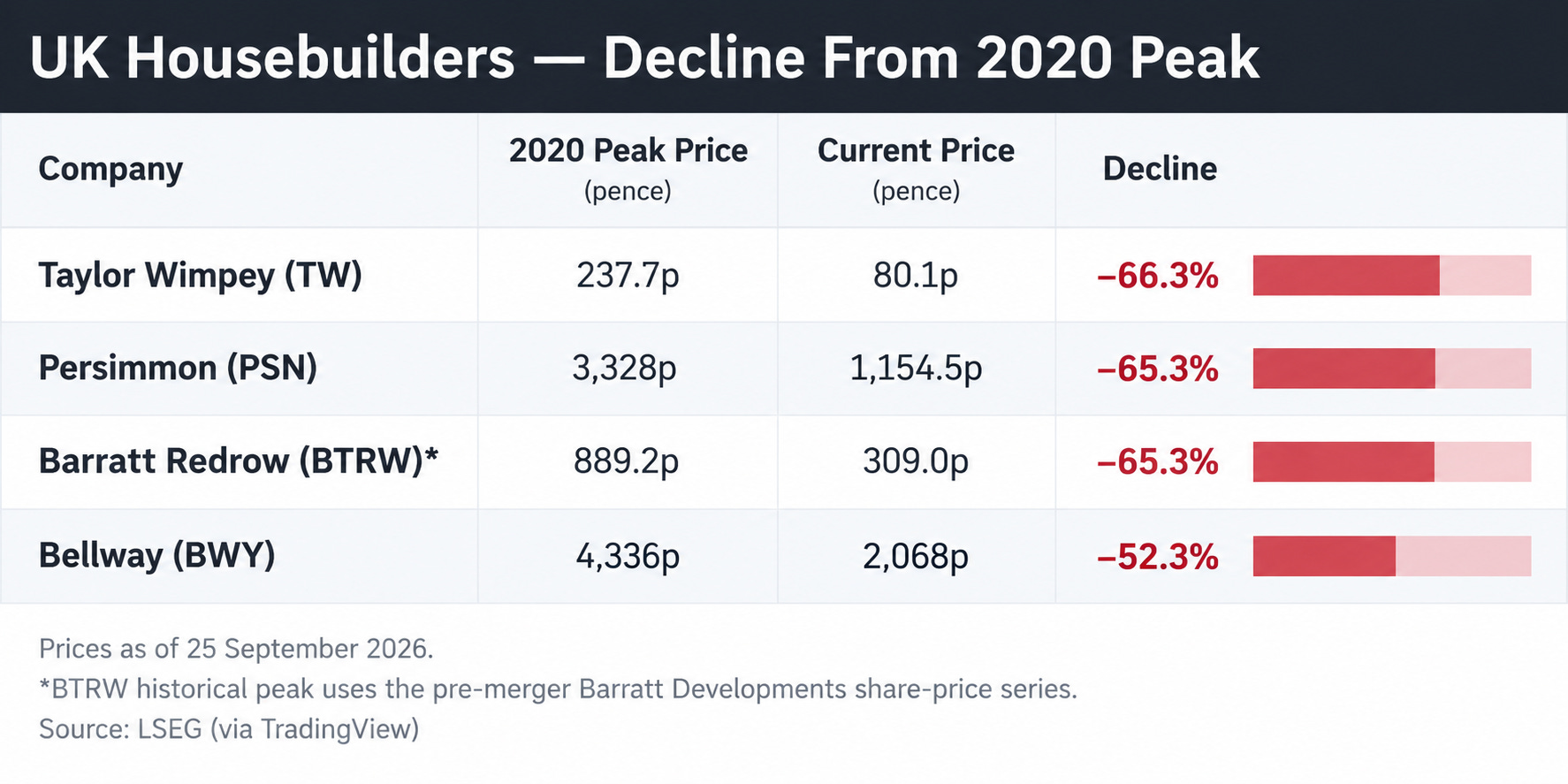
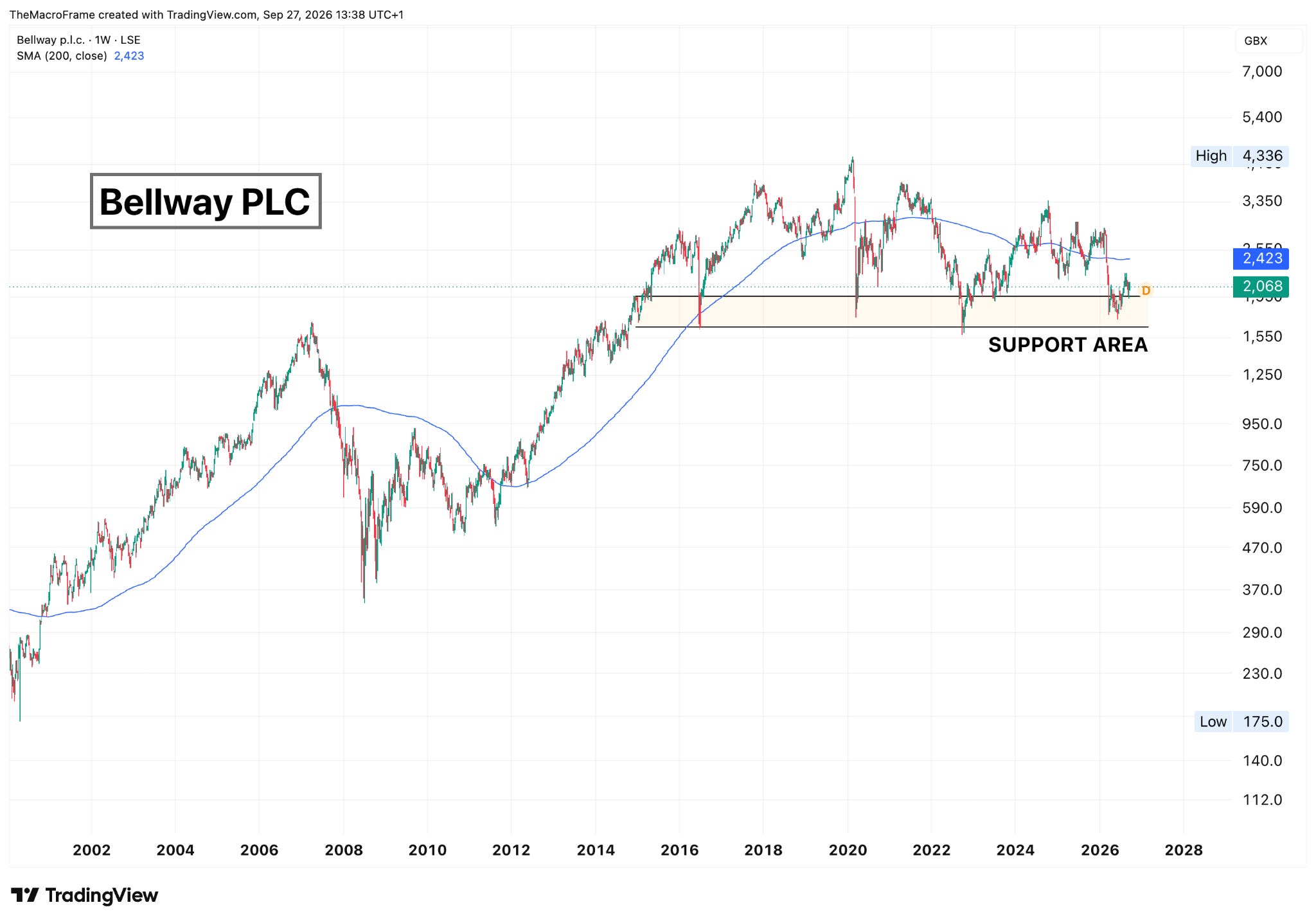
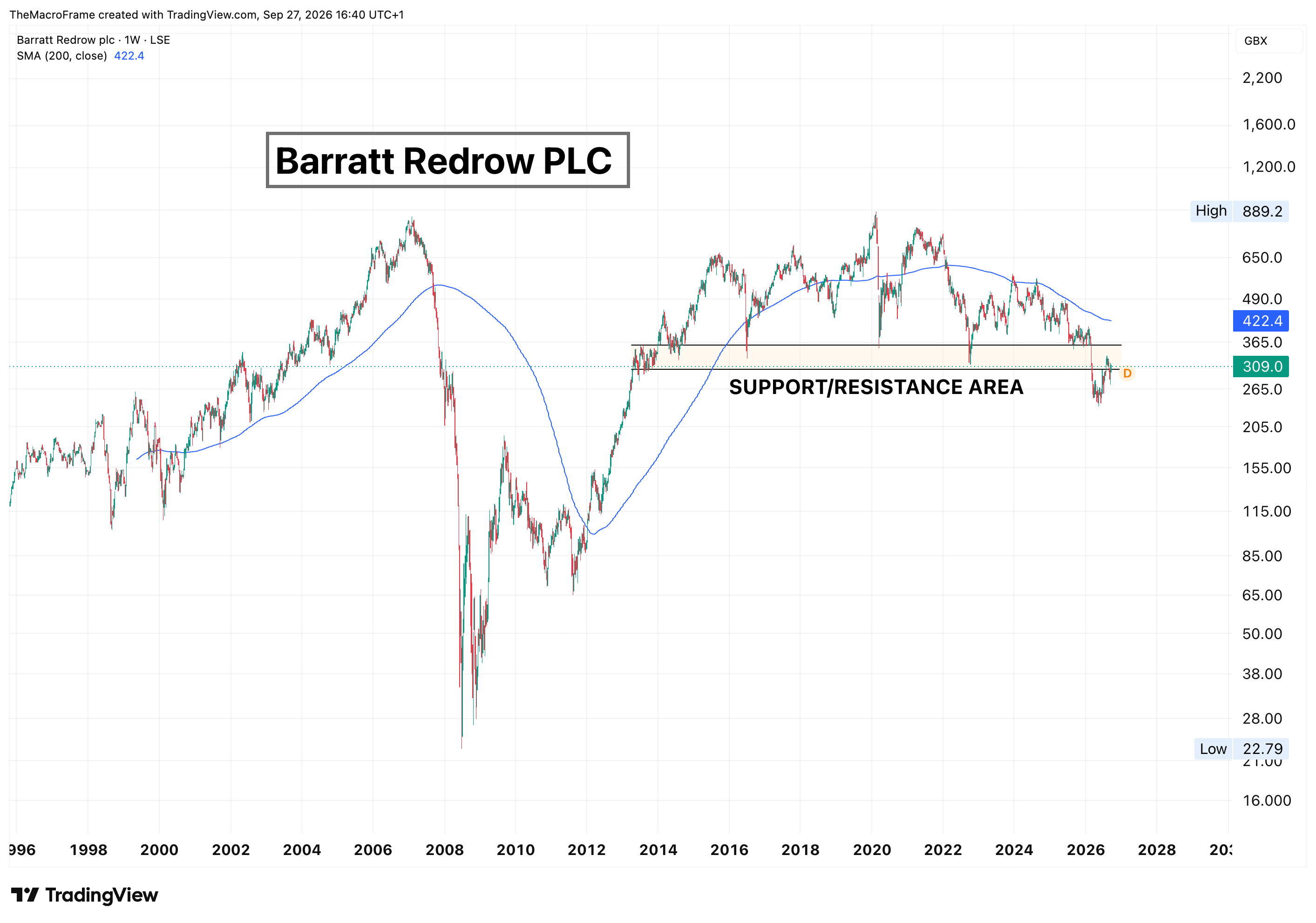
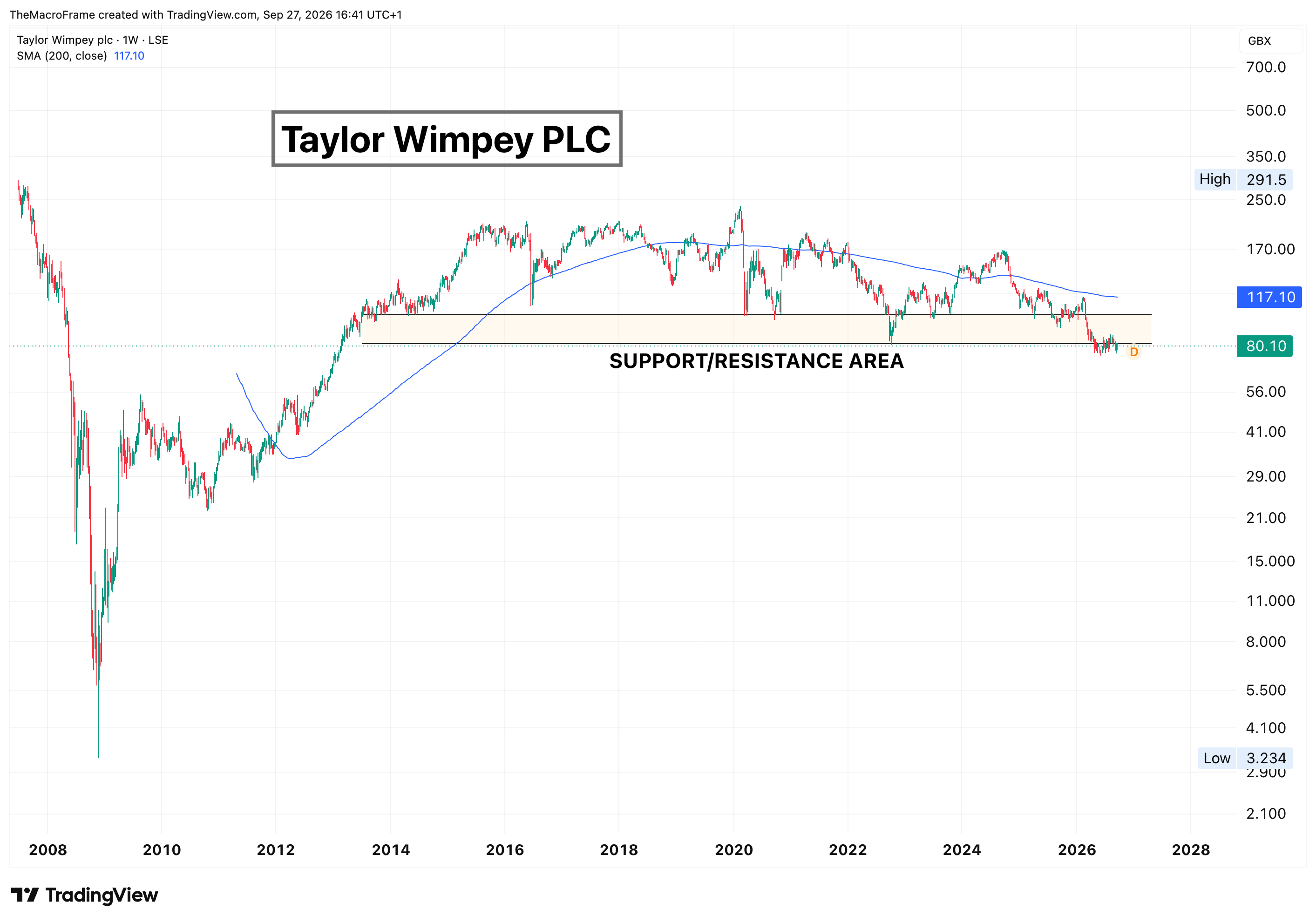
Alongside the depressed share prices shown above, sentiment towards UK housebuilders remains weak.
Morningstar recently lowered its value estimates for the main UK housebuilders by about 24% because of higher building costs and a weaker profit outlook.
JPMorgan lowered its 2027 profit estimates for UK housebuilders by about 20%, and downgraded Taylor Wimpey (LSE:TW) to underweight.
Persimmon (LSE:PSN) was relegated from the FTSE 100 in September.
As recently as August, Taylor Wimpey’s CEO described the housing market as being in a “prolonged downturn”, while Bellway was publicly calling for government-backed deposit support for first-time buyers.
Fundamentals
Despite a few difficult years, these housebuilders remain profitable and have solid balance sheets. Growth has slowed, and margins have been crushed, but these long-established businesses sit on large land banks and billions of pounds of tangible assets.
For housebuilders, I primarily look at the fundamentals through three questions:
1. What are we paying for the assets?
Housebuilders are asset-heavy businesses. They own land, partially built homes, completed homes and cash, offset by their liabilities.
Net tangible asset value (NTAV) is basically what remains after subtracting liabilities and removing intangible assets. P/NTAV shows how much the stock market is asking us to pay for £1 of those net tangible assets.
So:
1.0× P/NTAV = paying £1 for £1 of net tangible assets
0.7× = paying 70p for £1
1.5× = paying £1.50 for £1
A low P/NTAV doesn’t always mean a stock is cheap. If those assets don’t make good profits, the stock should be priced lower.
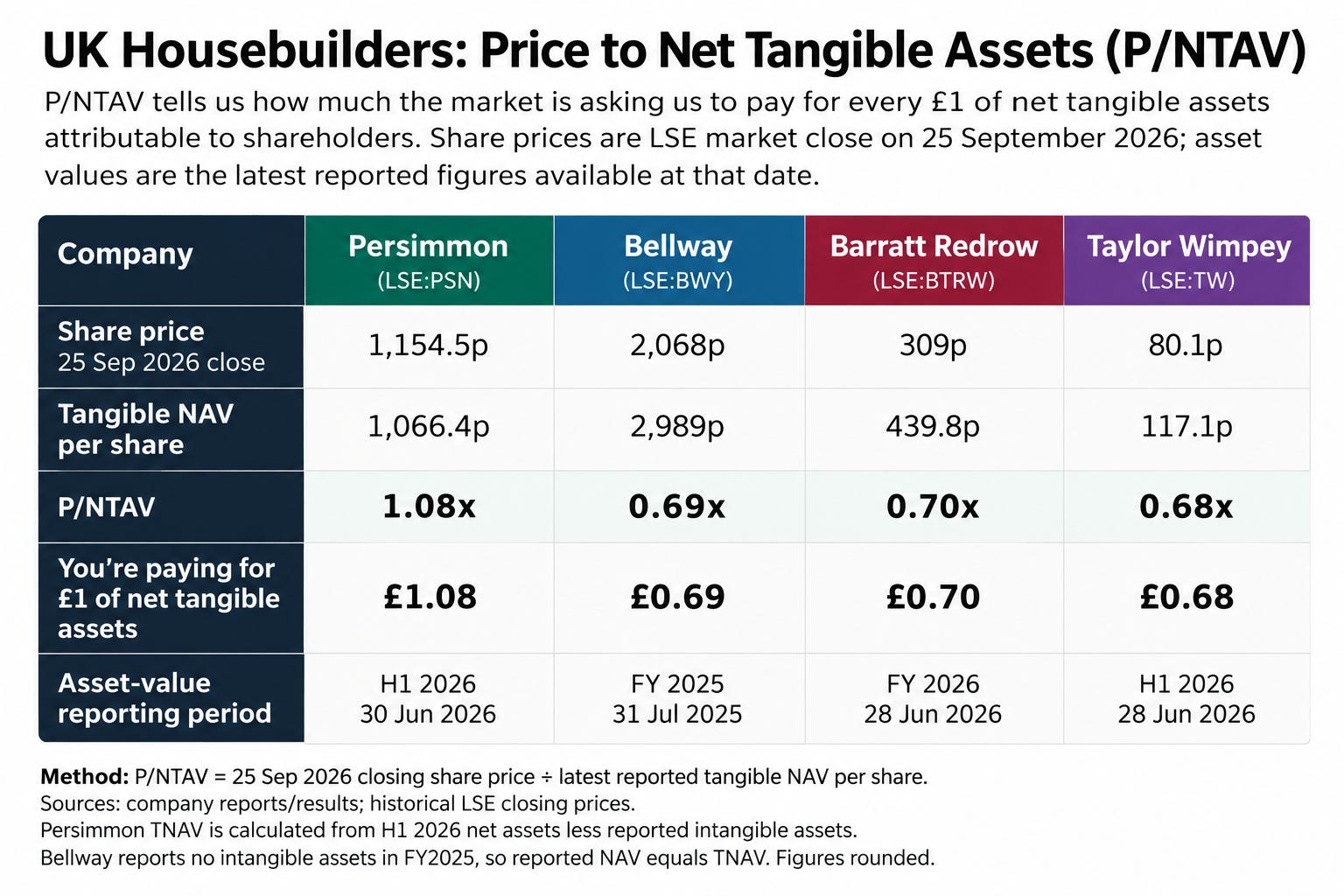
Barratt Redrow has started to use that discount to its advantage. In July, the company announced a £386 million share buyback while its shares were priced 36% below their tangible net asset value, saying this was a chance to boost returns for shareholders.
2. What return are those assets generating?
Buying £1 of assets for 70p sounds like a bargain, but it isn’t always one.
That £1 is an accounting figure, not a promise that the assets could be sold for £1. More importantly, these housebuilders aren’t closing down and liquidating their assets. Their land and stock need to generate profits.
If £1 of assets generates 15p of profit each year, paying 70p for them could be very attractive. If they generate only 2p, the discount may be justified.
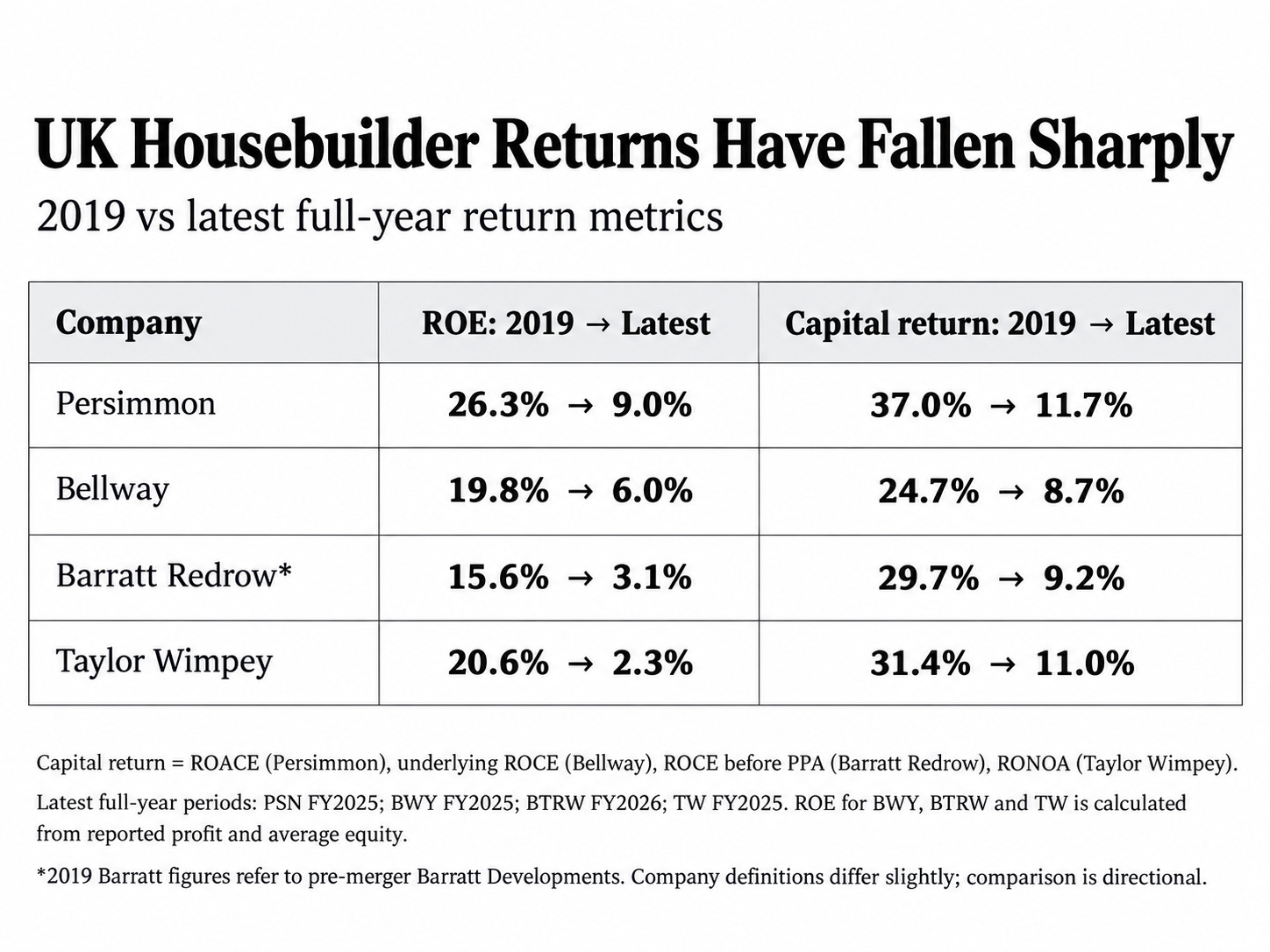
This is where return on equity (ROE) and return on capital employed (ROCE) come in.
ROE shows the profit a company generates from shareholders’ equity, while ROCE looks more broadly at the profit generated from the capital employed in the business. A 10% return means roughly £10 of annual profit for every £100 of the relevant capital base.
For a housebuilder, those returns are driven largely by two things:
Margin: how much profit it makes when it sells a house.
Asset turnover: how fast it can turn land and building costs into finished home sales and use that money for the next project.
Put simply, higher margins and increased sales from the same asset base translate into higher returns on capital.
As the chart below shows, returns have fallen substantially across UK housebuilders in recent years:
3. Can that earnings power recover?
For housebuilders, I’m watching three things:
Margins: Are selling prices rising faster than building costs, and are builders giving fewer discounts?
Volumes: Are they selling and finishing more houses, turning land and stock into cash faster?
Demand: Are mortgages becoming more affordable, and are buyers more confident and making more reservations?
The picture today is mixed, but some metrics are starting to stabilise:
Volumes show signs of recovery, but unevenly. Persimmon’s H1 completions rose 13% [1], Barratt Redrow’s FY26 completions rose 5% [2], and Bellway’s rose 11% [3]. Taylor Wimpey moved the other way, with H1 Group completions down 5% [4].
Demand remains mixed. Persimmon’s private forward order book increased 5% to £1.31 billion [1], while Barratt Redrow’s underlying private reservation rate edged up from 0.55 to 0.56 and its forward sales reached 11,200 homes, up from 10,593 a year earlier [2]. However, Bellway [3] and Taylor Wimpey [4] both reported lower reservation rates and smaller forward order books than a year earlier.
Margins remain under pressure. Persimmon’s underlying operating margin slipped from 13.1% to 12.8% in H1 [1], while Barratt Redrow’s adjusted operating margin before PPA fell from 10.5% to 9.9% in FY26 [2]. Taylor Wimpey’s H1 adjusted operating margin fell from 9.7% to 7.7% [4], while Bellway expects its FY26 adjusted operating margin to be around 10%, down from 10.9% [3].
Sources: [1] Persimmon H1 2026 results; [2] Barratt Redrow FY26 results; [3] Bellway FY26 trading update; [4] Taylor Wimpey H1 2026 results.
This is where Your First Home becomes especially interesting.
The policy could improve these variables.
Research into the previous Help to Buy scheme in England estimates that it increased new housing supply by around 15% over its lifetime. It also found evidence that the scheme pushed up prices in some areas, including a roughly 1% premium on Help to Buy new-build homes compared with otherwise similar properties.
That’s potentially important for housebuilder economics. More buyers can support higher volumes; stronger pricing can support margins; and selling more homes from the existing asset base can lift returns on capital.
I don’t need margins or returns to return to their previous peaks for the thesis to work. A partial recovery in volumes, margins and returns from today’s depressed levels could be enough to materially change how the market values these businesses.
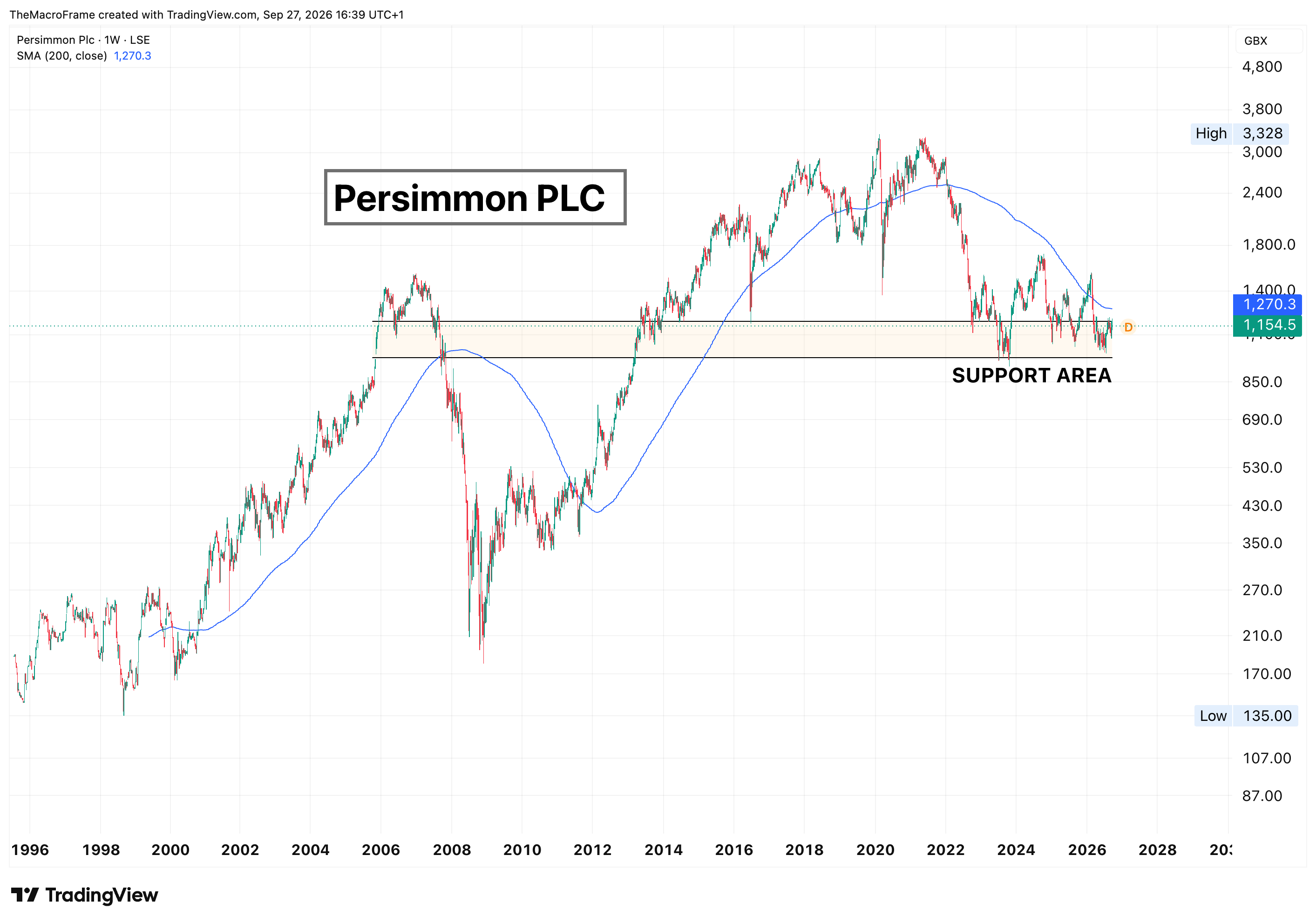
Technicals
All four shares remain well below their cyclical highs and long-term trends. Persimmon currently shows the clearest signs of technical improvement, although a sustained move above its 200-week moving average would provide stronger confirmation that the trend is changing.
Conclusion
There are still plenty of risks. Mortgage rates remain elevated, build costs could continue to squeeze margins, developers could be asked to contribute to the scheme’s costs, and the scheme itself may disappoint.
More fundamentally, today’s lower returns may be the new normal.
With sentiment and valuations already depressed, Your First Home does not need to transform the housing market to matter. Even a modest improvement in demand could challenge the market’s pessimistic assumptions and lead to a sustained rise in share prices.
Disclaimer
This article is for informational purposes only and is not financial advice. I may hold positions in the discussed companies and trade them without updating this article. Unless stated otherwise, market and valuation data are as of 26 September 2026. Views are my own. Investing involves risk, including loss of capital.
I like how you separate the asset discount from the question of what those assets can actually earn. The proposed scheme could help builders sell more homes, but the decisive test may be whether that demand improves returns without simply being absorbed by higher land costs or buyer incentives. Your comparison across the four companies makes that worth watching individually: the same policy could reach their margins and balance sheets in quite different ways.