

Overview
The commodities bull market is in full swing. Since 2024, prices across energy, metals and agricultural markets have risen, although the market is now approaching a significant resistance level.
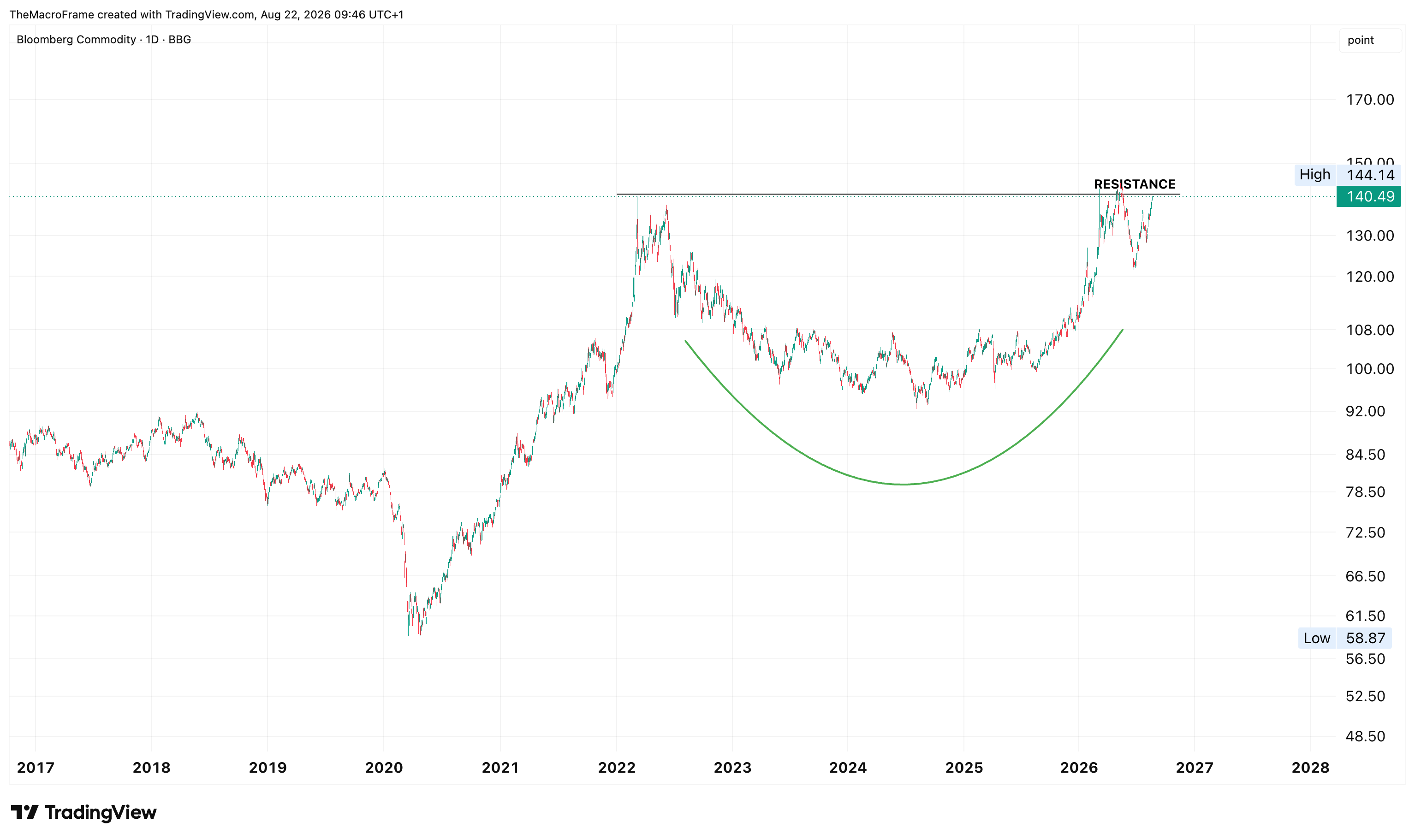
Markets tend to respect multi-year resistance levels, so a period of consolidation or a correction would not surprise me. However, I think the catalysts driving this bull market will persist through the rest of the decade and eventually push the market through that resistance.
I am especially bullish on gold, silver and industrial metals, as well as oil, gas and nuclear. I have laid out the underlying thesis for each in previous research.
If these commodities have further upside, the next question is which countries, and which companies within them, are well positioned to benefit?
I am looking for regions with access to these commodities in large quantities, alongside the infrastructure and industry needed to process them profitably. I am particularly interested in whether each region can:
Effectively turn underground resources into commercially viable assets.
Create additional value through processing, refining, and infrastructure.
Offer investors a practical way to capture that value.
Africa
Africa holds about 30% of the world’s mineral reserves and around 8% of the world’s proven oil and natural-gas reserves. Its mineral wealth includes copper for electricity grids, uranium for nuclear power, and platinum-group metals (PGMs) for vehicles and industrial catalysts.
From Underground Resources to Commercial Assets
Africa is rich in energy and mineral resources, but those resources are spread unevenly. Oil and gas are concentrated in North and West Africa. Gold production is significant across West and Southern Africa, copper is concentrated in Zambia and the Democratic Republic of Congo (DRC), and South Africa dominates PGMs. Namibia and Niger are key uranium producers, with Namibia alone accounting for approximately 12% of global mined output in 2024.
Discovery
Despite covering 22% of the world’s landmass, Africa attracted only 10% of global mineral-exploration spending. However, the exploration that occurs has produced more discovery value per dollar than in established mining jurisdictions.
Between 2007 and 2016, Sub-Saharan Africa generated approximately $0.80 in estimated mineral-discovery value for every $1 spent on exploration, compared with $0.60 in Canada, $0.50 in Australia and $0.30 in Latin America.
Processing and Refining
Oil
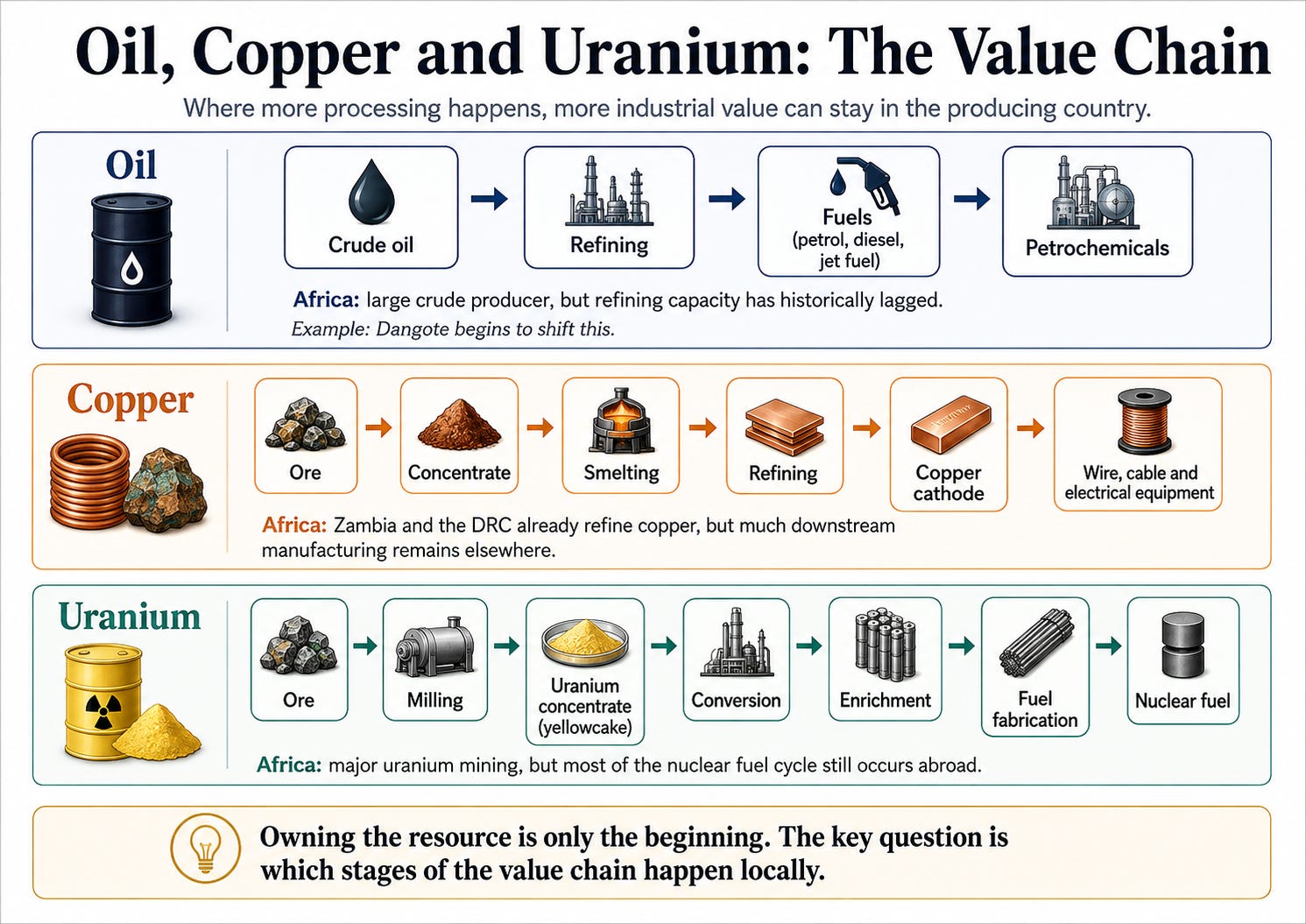
For generations, Africa has exported crude oil, paid foreign refiners to process it, and then imported more expensive petrol, diesel and other fuels.
This is changing. The Dangote refinery in Nigeria, Africa’s largest, was commissioned in 2023 and began ramping up production in 2024, helping transform the country into a major producer of refined fuels. The project cost more than $20 billion and took roughly a decade to complete, but it demonstrates that highly complex industrial projects are being built and operated successfully on the continent.
Dangote now plans to build a second, even larger refinery in Lamu, Kenya, although this remains a proposal and will take years to finance and construct. If completed, it would further reduce Africa’s dependence on imported fuel and allow more of the value chain to be captured domestically.
Copper
Copper must be concentrated, smelted and refined into high-purity metal before it can be turned into wire, cable and electrical equipment. Zambia and the DRC already perform significant copper processing and refining.
Uranium
Uranium has an even longer chain: African producers such as Namibia largely export uranium concentrate, or “yellowcake”, which must then be converted, enriched and fabricated into nuclear fuel abroad.
Transport
Across much of the continent, inadequate roads, railways and ports raise extraction costs, reduce mine profitability and leave some deposits undeveloped.
Africa is large enough to contain China, India, Europe and the United States, yet its 82,000-kilometre rail network is only slightly larger than India’s 69,400-kilometre network, and, according to the World Bank, 16% of Africa’s rail infrastructure is entirely non-operational.
Ports present another bottleneck: cargo waits almost three weeks at Sub-Saharan African ports on average, compared with less than one week in several other regions, while handling costs are around 50% higher.
Consequently, 80% to 90% of African freight travels by road, yet only 28% of the continent’s 2.8 million kilometres of roads are paved.
The challenge is particularly acute for landlocked resource producers. In Zambia, where the extractive sector accounted for 77% of exports in 2019, transport expenses have added around 40% to the cost of mining output.
Power
Africa exports energy to the world, while much of the continent still lacks the power needed to process its own resources.
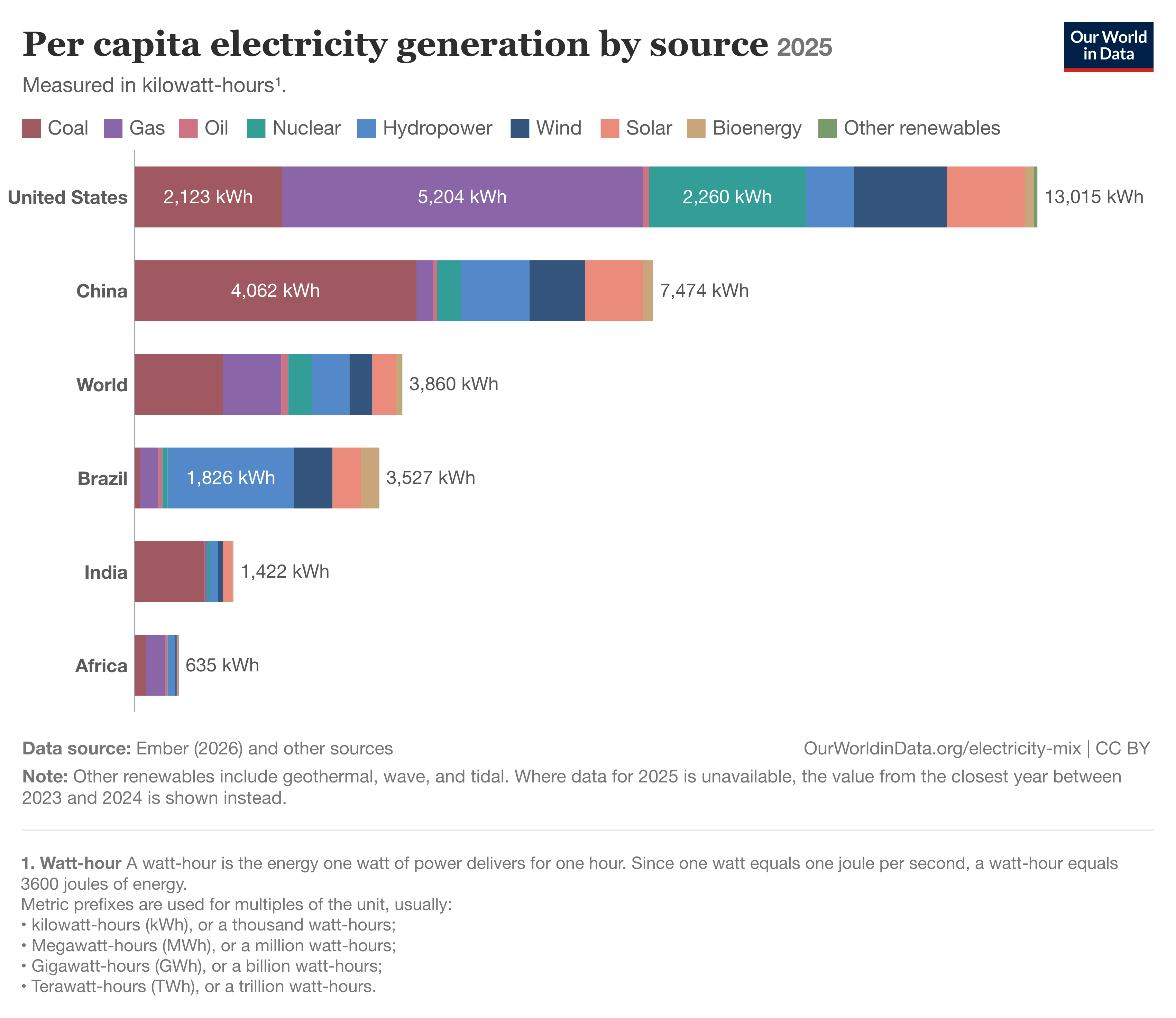
In 2025, Africa generated just 635 kilowatt-hours of electricity per person, around one-sixth of the global average. This reflects both limited access to electricity and the continent’s relatively small industrial power base.
Insufficient supply makes it harder to develop and process resources domestically. Mines, smelters and processing facilities require enormous amounts of reliable power. Where the grid cannot meet their needs, mining companies must absorb the cost of outages or build their own generating capacity.
I expect substantially more investment in electricity generation and transmission across Africa over the next decade as population growth, urbanisation and industrial development increase demand while making large infrastructure projects more economically viable.
China’s Role
China has played the most prominent external role in financing Africa’s infrastructure gap. Between 2000 and 2023, Chinese lenders committed $182 billion to African borrowers, including nearly $53 billion for transport.
China has helped build much of the infrastructure needed to commercialise Africa’s resources, while also securing significant exposure to those resources itself. Chinese state-owned and private companies have become major owners, operators and financiers across African mining and broader industries, but much of that exposure sits in firms that are difficult for investors to access directly.
Where Does Value Accrue?
For every $100 of economic rent (the value of resources minus production costs) generated by natural resources in resource-rich Sub-Saharan Africa, the World Bank estimates that governments collect around $38.
The remaining $62 goes to a combination of domestic and foreign owners, state-owned companies and retained or reinvested earnings, although the precise distribution is difficult to track.
Kamoa-Kakula, one of Africa’s largest copper mines in the DRC, is one example of how resource value can be divided:
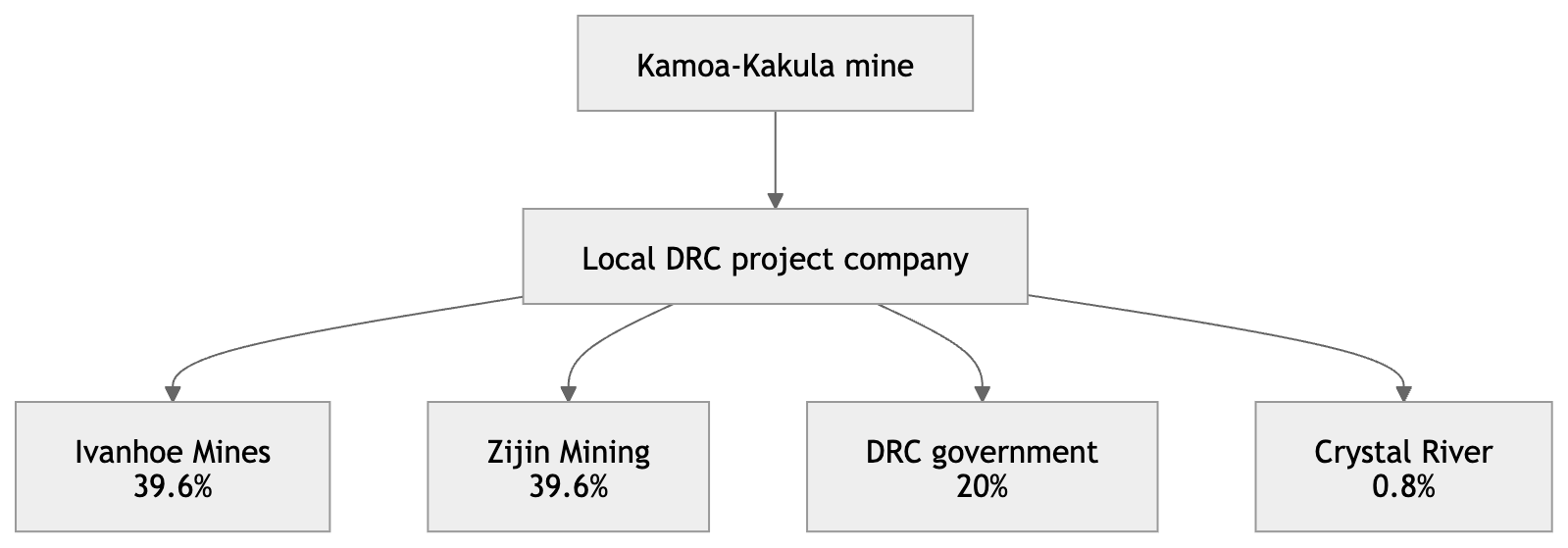
In 2025, the mine generated $3.3 billion in revenue and $1.45 billion in EBITDA. The DRC captures value through its ownership stake, taxes, wages and local economic activity. But foreign-owned companies retain claims on most residual profits after costs and reinvestment.
Country and Company Selection
The next step is to apply this framework at the country and company level. I am looking for countries where resource abundance is translating into commercially viable production and greater value capture, and for listed companies that offer a practical way to invest in that process.
Zambia
Zambia is one of Africa’s most important copper producers at a time when electrification, grid expansion and data-centre construction are increasing the strategic importance of the metal globally.
Zambia has been mining copper industrially for almost a century and already possesses large deposits, experienced workers, concentrators, smelters and an established mining industry.
It’s not without its problems — Zambia still relies heavily on hydropower, leaving electricity generation vulnerable to drought. It can also be constrained by difficult transport links and inconsistent policy.
But the outlook is improving: copper production rose 8% to a record of almost 890,000 tonnes in 2025, despite severe electricity shortages, and the government expects production to exceed one million tonnes in 2026. Its more ambitious target is three million tonnes annually by 2031.
The political backdrop is supportive, too. President Hichilema’s government is trying to capture more value from the mining industry rather than simply exporting greater volumes of raw material, including through domestic processing, state participation and plans for a pan-African metals exchange.
First Quantum Minerals (TSX:FM)
First Quantum provides a clear expression of this thesis. Its Zambian operations capture much of the copper value chain.
Sentinel, First Quantum’s biggest copper mine and one of Africa’s largest, moves around half a million tonnes of material in a single day.
Moving that much rock is an enormous logistical and energy challenge in itself. One example of First Quantum’s engineering ingenuity is its use of trolley-assist lines, which allow electric-drive haul trucks to draw power directly while climbing out of the pit, reducing diesel consumption by 90%.
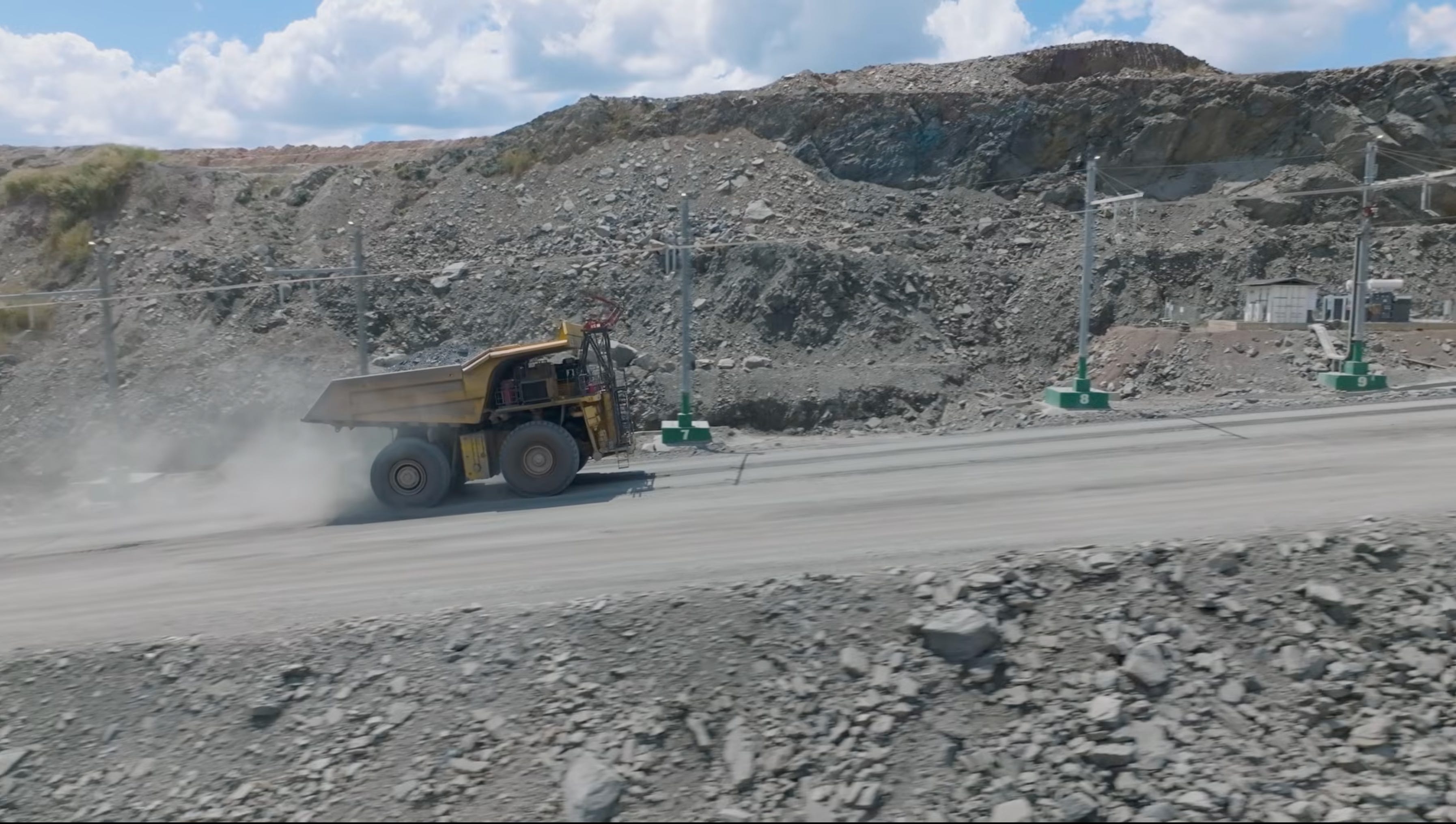
Nearby sits Enterprise, a nickel mine that shares infrastructure with Sentinel. Its ore is hauled around 15 kilometres to the same processing complex, helping lower the cost of producing a completely different metal.
First Quantum’s Kansanshi complex includes an integrated smelter that processes concentrate from both Kansanshi and Sentinel. After crushing, milling and flotation, the resulting concentrate is only around 23% copper. At Kansanshi, it is smelted, converted and refined until 99.9% pure copper plates come out the other end.
One major complication lies outside Zambia. Cobre Panamá, formerly First Quantum’s largest mine, has been suspended since 2023. A reopening would materially improve the company’s financial position, but would also make First Quantum a less concentrated Zambia investment.
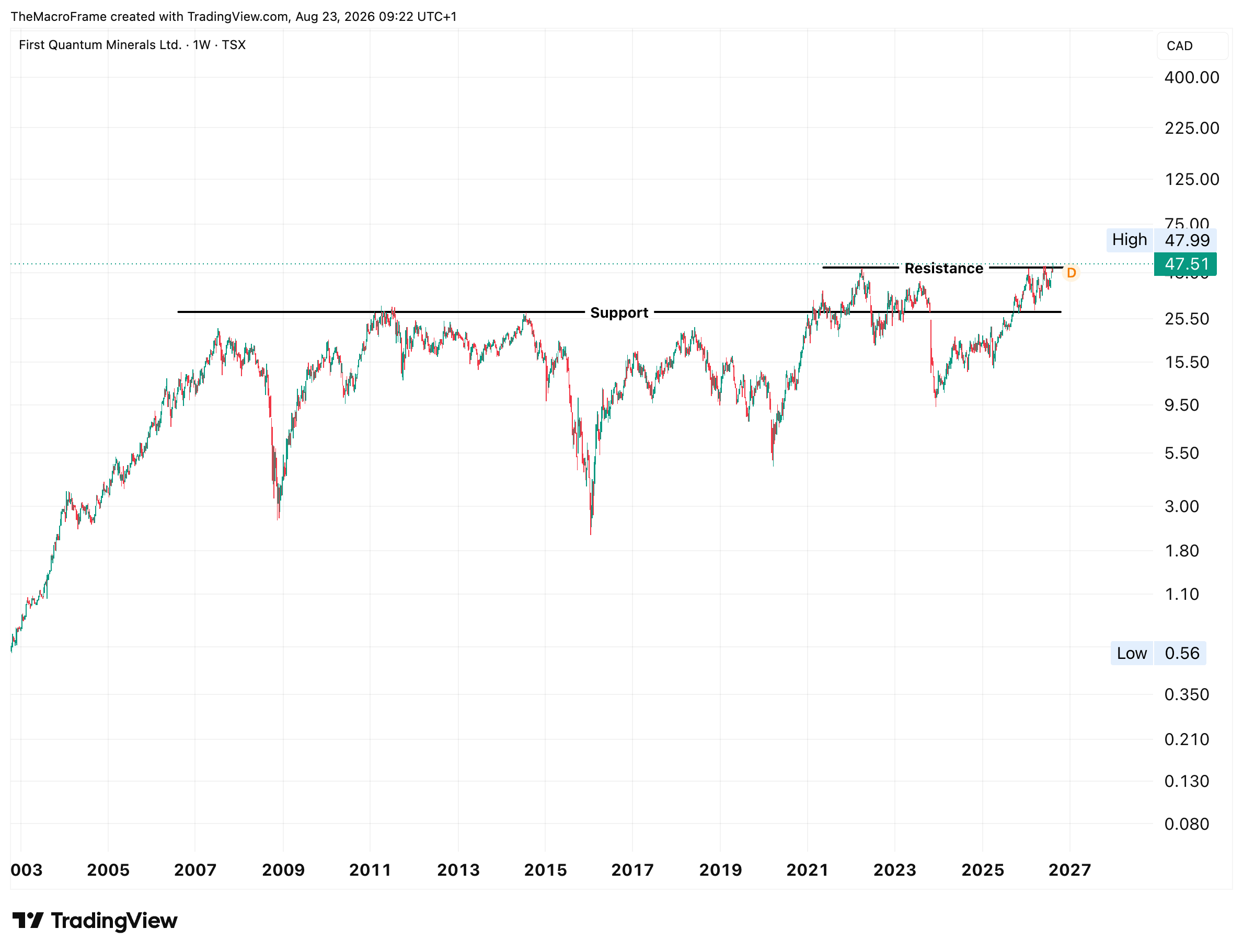
Technically, First Quantum is attempting to break above a major resistance zone around C$45–48, an area that has capped the shares several times since 2022. Below that zone, the C$25–30 region provides strong historical support. A sustained breakout above the recent highs would strengthen the longer-term bullish setup.
Namibia
Namibia is one of the world’s largest uranium producers, supplying 12% of global mined uranium in 2024. Mining is well established, while major offshore oil discoveries since 2022 could eventually broaden the country’s resource base considerably.
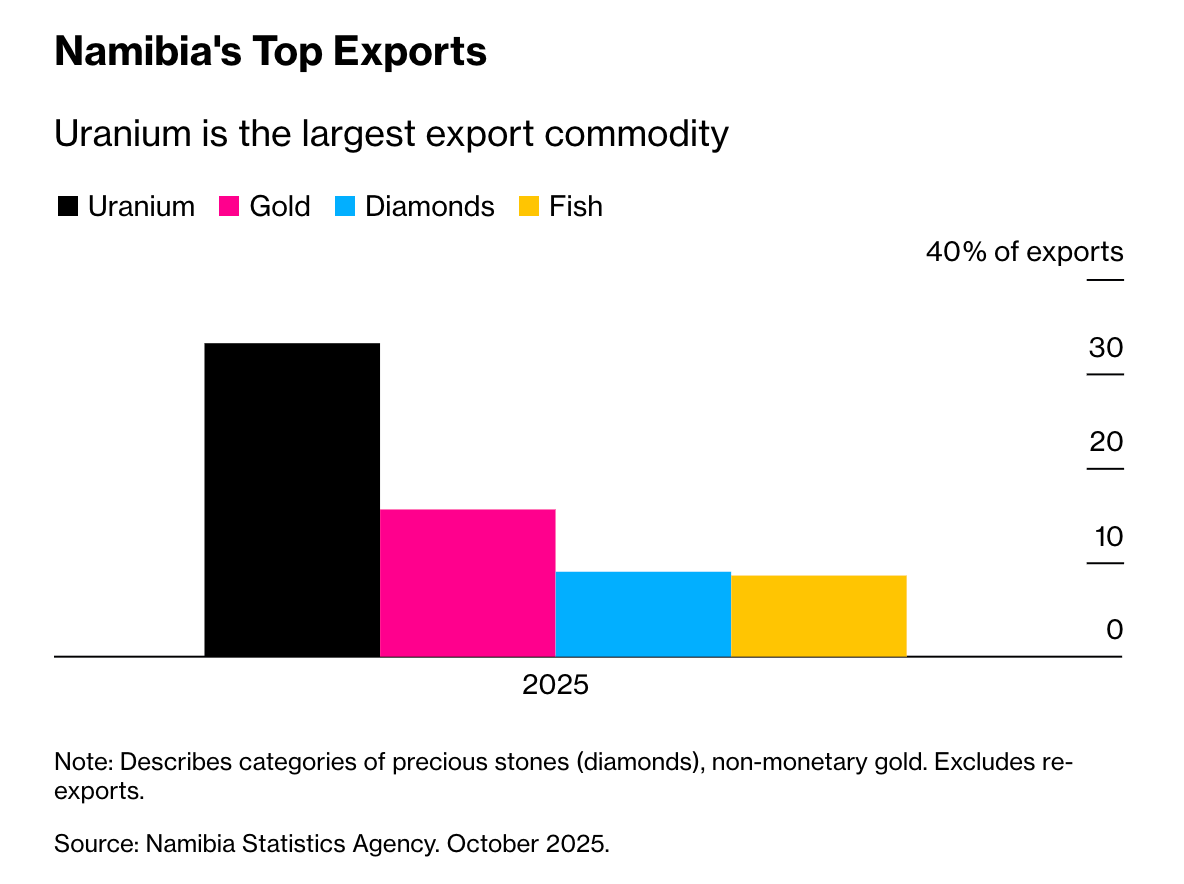
What makes Namibia particularly interesting is its ability to commercialise those resources effectively. It combines relative political stability with some of Africa’s stronger transport infrastructure, including motorways, railways and access to the Atlantic through Walvis Bay. The port also connects Namibia to landlocked resource producers in Zambia and the DRC, giving the country a wider role as a regional logistics hub.
Namibia’s mining sector faces notable constraints, including water scarcity, economic dependence on South Africa, and persistent structural inequality, while much of the existing uranium industry is foreign-owned.
For investors, Namibia’s domestic stock market is small, but its resources are accessible through some internationally listed companies. Paladin Energy (ASX:PDN) offers exposure to uranium already in production, while Deep Yellow (ASX:DYL) and Bannerman Energy (ASX:BMN) provide greater development-stage leverage through prospective mines.
Bannerman Energy (ASX:BMN)
Bannerman Energy is a concentrated expression of the thesis in Namibia. Its entire value rests on Etango: a large, permitted uranium project situated within Namibia’s established Erongo mining district, close to existing infrastructure.
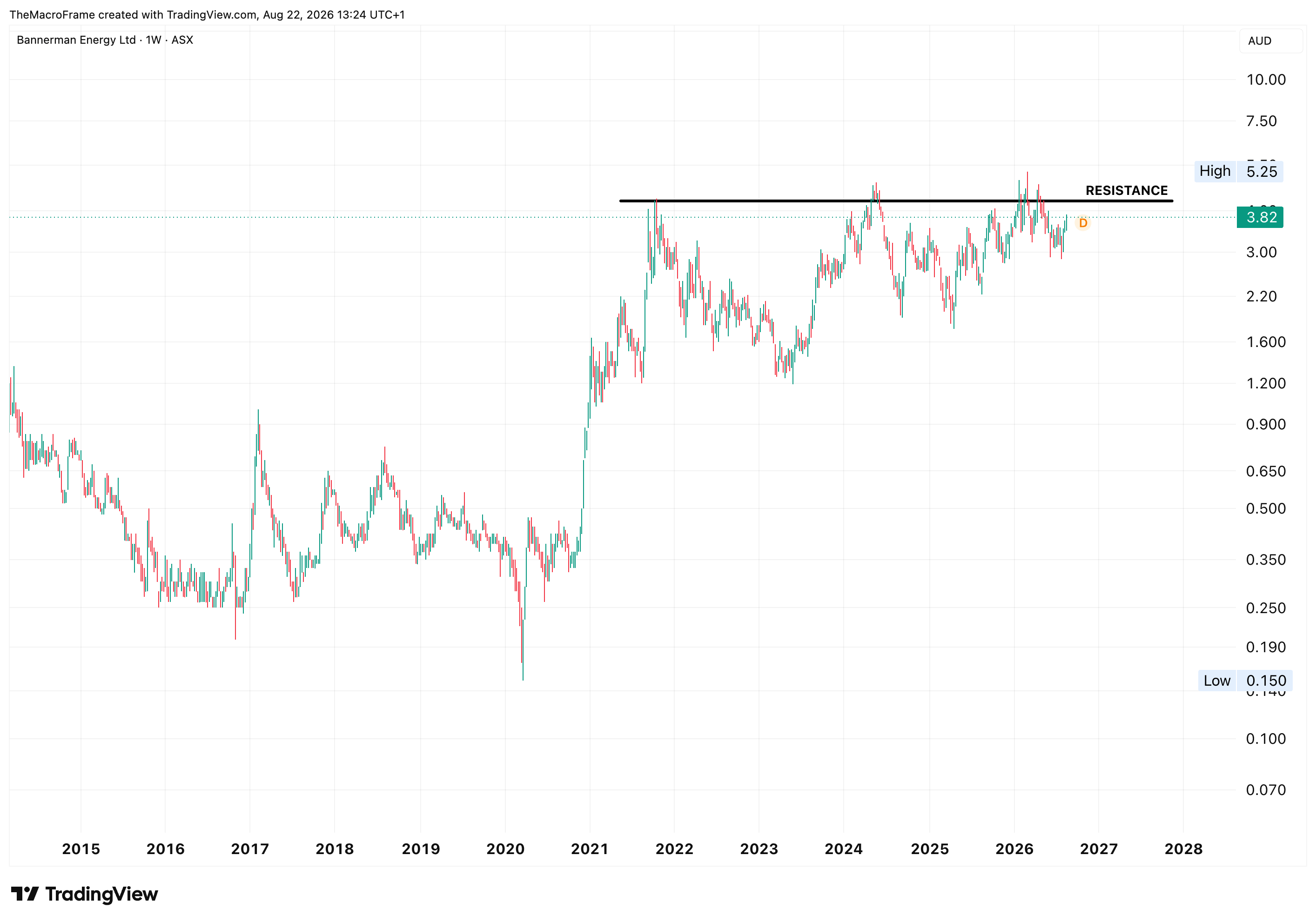
Technically, Bannerman has been building a large consolidation base since 2021. I like these multi-year formations when they coincide with improving fundamentals: rising nuclear-power demand, constrained uranium supply and an established mining jurisdiction with the infrastructure to support development.
South Africa
South Africa has a more mature economy than most of its peers. Less well known is that it is also the world’s largest platinum producer, holding approximately 88% of global platinum-group metal reserves.
The largest source of platinum demand comes from catalytic converters, which reduce emissions from petrol and diesel vehicles. Electric vehicles do not require these devices, creating a potential long-term headwind. But like silver, platinum has both industrial and precious-metal uses, meaning demand can come from industry as well as investors seeking scarce physical assets.
South Africa already possesses an established industrial base, including mines, smelters, refineries, skilled workers and the continent’s largest stock exchange. Mining contributes approximately 7–8% of GDP and accounts for more than half of exports.
The challenge is that this industrial base has been undermined by unreliable electricity. Mining and smelting consume approximately 30% of South Africa’s electricity, making power shortages particularly damaging. But reforms allowing companies to generate more of their own electricity suggest these constraints are beginning to ease.
Valterra Platinum (JSE:VAL)
Valterra Platinum offers one of the clearest expressions of the thesis. Its operations include Mogalakwena, one of the world’s largest platinum-group-metal mines, alongside an integrated network of concentrators, smelters and refineries.
Mogalakwena is extremely productive. The World Bank found that output per worker at the mechanised mine was approximately 11 times higher than at a conventional platinum operation, while production costs were around 44% lower.
The core thesis for platinum relies on supply constraints. Electric vehicles remain a long-term headwind to catalytic-converter demand, but petrol vehicles, hybrids and plug-in hybrids are likely to remain important for longer than the market expects. Platinum can also gain demand through substitution for palladium, jewellery and investment. In an already tight market, demand may only need to remain resilient for deficits to persist.
Valterra combines exposure to a constrained PGM market with the advantages of a modern, integrated and relatively low-cost producer.
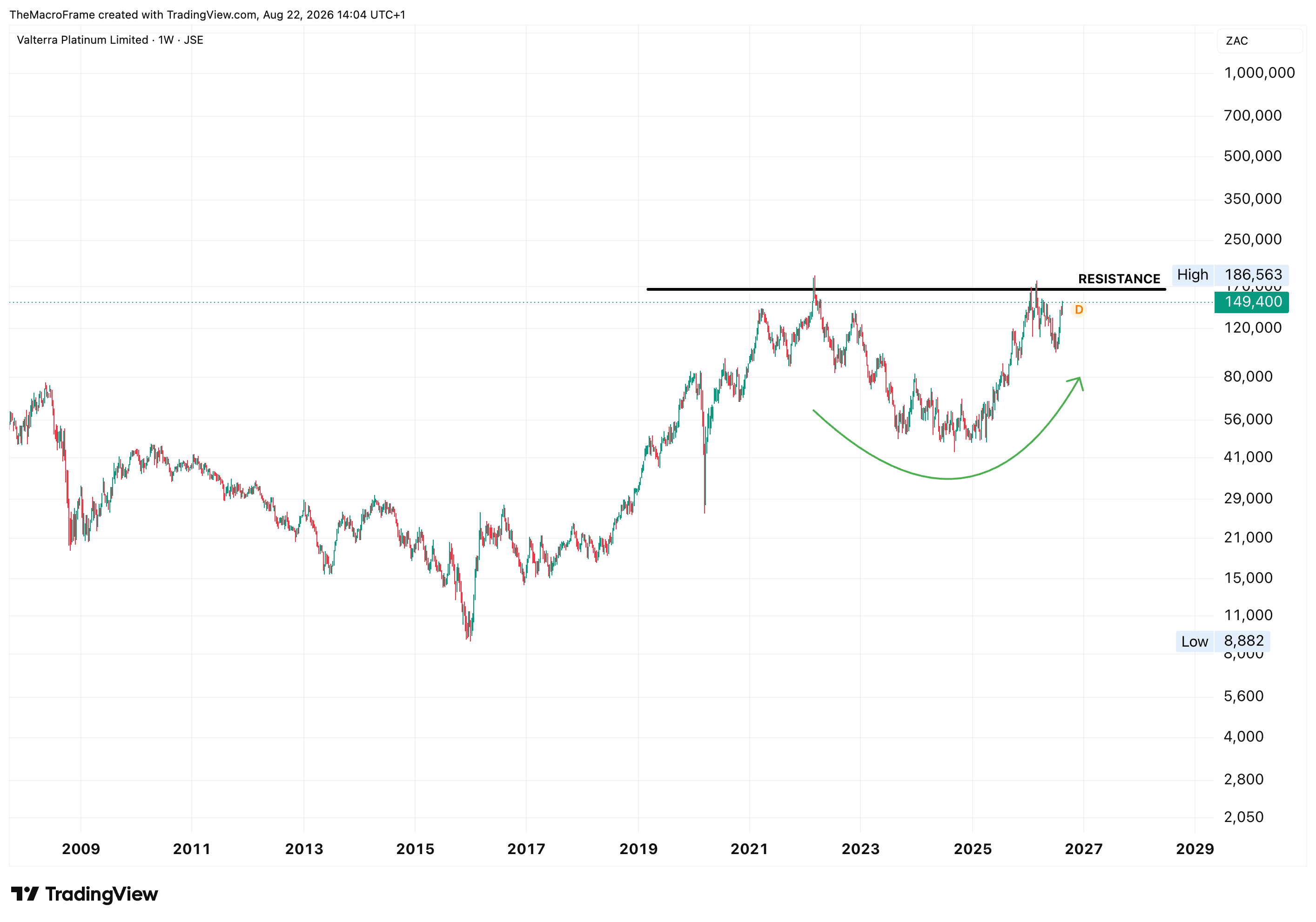
Technically, the shares have been forming a rounded base since 2023, which I like when it coincides with improving fundamentals. However, the 2025 rally in metal prices and earnings has already driven a substantial rerating. In fact, the stock has already rallied 20% while I was finishing this article!
If we take a historical look at growth of nations due to exploration of natural resources , except for gulf nations , ordinary people in very few countries have benefitted due to exploration of natural resources. Besides , Africa is hampered by having a lot of landlocked nations.
More than the common populance of Africa , this will benefit China.
I will be glad to be wrong for the sake of progress of common populance of Africa